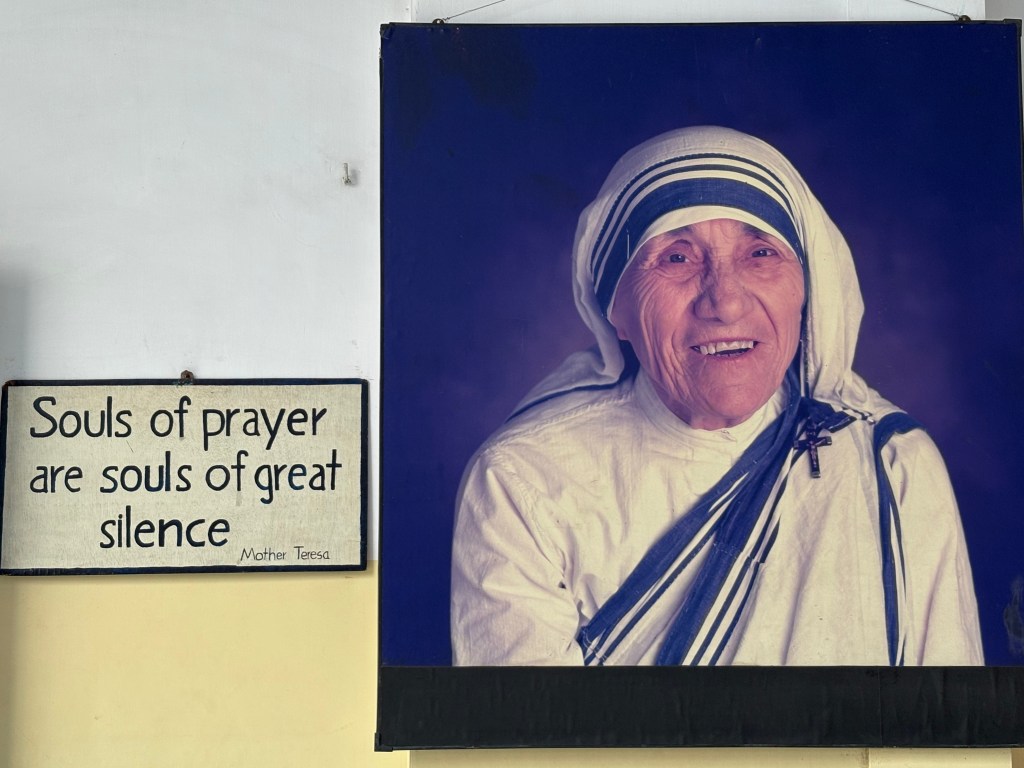
Over the latter half of the 20th Century, the Mother House of Saint Teresa became a wellspring of divine love, flooding the world with compassion and service directed at the poorest of the poor, all springing from the boundless heart of a diminutive woman answering a call from Jesus. On a quiet Sunday morning I walked to this modest headquarters of the Missionaries of Charity and paid homage to one of the greatest saints that ever walked this earth.
On September 10th, 1946, Mother Teresa received a “call within a call” on her way to Darjeeling for her annual retreat. Jesus asked her to begin a religious community that would serve the poorest of the poor. She soon started working in the worst slums of Calcutta, visiting the destitute in their homes or on the street; she started opening schools and dispensaries. At the time of her death in 1997, there were 3,914 sisters working through 594 missions in 123 countries, and she ran it all from this house.
A small inner courtyard led to a large room containing her tomb, the tiny room where she lived, and to a small museum with artifacts, personal belongings, letters, photos, awards, paintings and other memorabilia that celebrated her life. Three stories rose above this courtyard and housed nuns currently working here, who could be seen walking along the terraces and who had already answered the two week, “Come and See” experience at one of the vocation centers, after which they dedicated their lives to serving the poor.
What resonates deeply in my heart about Mother Teresa is not just what she did, but how she did it. She recognized immediately that the poor not only hunger for material goods, but they need love, recognition, human contact. “What these poor need desperately is genuine kindness!” she exhorted her sisters. Indeed, during my own meagre attempts to feed the poor in California, I found that those I helped cared more about my smile than the burritos I gave them, or my kind words. They lapped up any sign of tenderness and recognition like famished souls.
It’s not hard to wonder why. Our society abhors the poor. We make it a crime to be on the street, even though the destitute often have nowhere else to go. We naturally go out of our way to ignore them, because to see them, to really, really see them, would condemn everything our society celebrates as a success. The extreme inequality that ravages our planet is perhaps the greatest crime against humanity. It festers within every human endeavor and condemns every grand achievement with the stark reality of immense suffering. We all see it. Every day. Or choose not to.
What to do about it is a question for every individual to consider. I know my heart ached as I stood at Mother Teresa’s tomb, feeling the hypocrisy inherent in all my spiritual ambitions. I learn again and again that you can’t go halfway on this path; you can’t fake it with God. That’s what I’ve done most of my life. I am not saying this to drown myself in self-guilt, but rather to gain wisdom into the human heart, and to understand the inner work that lies ahead, to never grow self-complacent and proud of my progress, because there is always further to go.
After all, when a rich young man asked Jesus what to do to follow him, Jesus answered, “If you want to be perfect, go, sell your possessions and give to the poor, and you will have treasure in heaven. Then come, follow me.”
The young man became sad and left, for he didn’t want to sell his riches. Neither do most of us. Perfection is hard to reach, and we don’t necessarily have to reach it, but rather to strive toward it as close as we can. Open our hearts more to those in need, first in our smaller circle, and then expanding outward. We will help ourselves as we help others.
Mother Teresa did reach that perfection. And the world celebrated her for that, because we knew she was right.
“The fruit of silence is prayer; the fruit of prayer is faith; the fruit of faith is love; the fruit of love is service; the fruit of service is peace.” — Mother Teresa


 Divine Warrior
Leave a comment