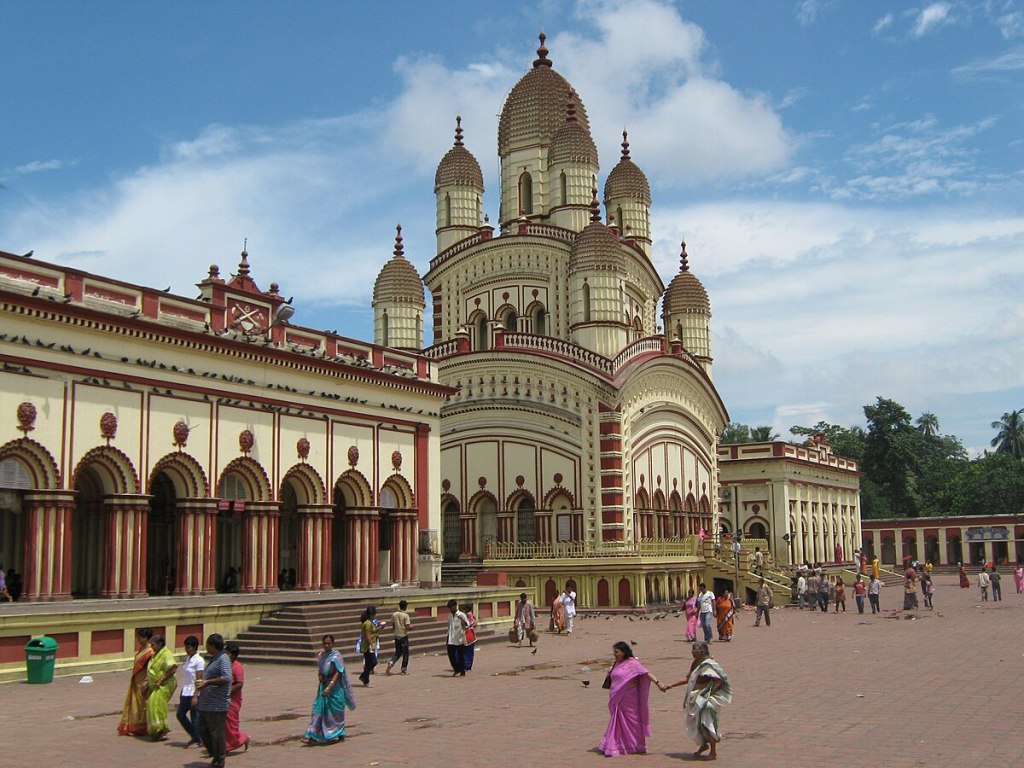
The Dakshineswar District of Kolkata where I am staying is perhaps most famous for the Kali Temple where Sri Ramakrishna lived for thirty years, along the eastern banks of a tributary of the Ganges River. Our ashram is less than a mile away, so in the morning Anders and I navigated through our neighborhood’s narrow streets, passing a man slaughtering chickens, families hanging their wash, and heaps of garbage that dogs and cows picked through in search of food. It was depressing and exhilarating all at once, just like the contrast between the happy faces all around us and the level of poverty in plain sight.
We split up for some time outside the temple grounds. Anders went towards the river and I entered a building where Sri Ramakrishna had lived for 16 years, then meandered through the crowd outside toward the ghat where many worshipers “cleansed” themselves in the Ganges before performing Puja inside the temple. The waters looked anything but clean, but that didn’t seem to dampen the enthusiasm on the ghat stairs where families, saddhus, young and old delighted in the cleansing process.
Numerous bronze statues of yogis in meditation sit along the sacred bank of the river, commemorating many of the disciples of Sri Ramakrishna as well as other historical figures. It’s like walking through the football or baseball Hall of Fame in America. Indeed, one could make a comparison between India’s fervor for religion and America’s obsession with sports. Both are approached with the same zeal but for quite different reasons.
Anders and I met up, checked our cell phones and shoes at a dilapidated stall, and drew a lot of attention as the only white guys around as we passed through security and onto the temple grounds. We walked across the huge courtyard and stopped at minor temples where worshipers gathered in front of arches under which bored-looking Brahman priests, robed in white and sitting cross-legged on the stone floor, faced the thronging masses desperate for some deliverance from the misery of this world. As the masses pushed up to them one after another they accepted their donations.
In front of a smaller replica of the Kali statue I saw a man weeping and begging and cajoling for aid. Others rushed down from the these stairs and went to stand in line to offer red hibiscus flowers and sweets to the Goddess Kali. As Anders and I stood in line, I mumbled, “We forgot to get a donation.” As we slowly mounted the steps to the statue of the goddess, the worshipers pressed against each other, eager to get to Ma Kali. As I finally muscled my way to a view of the inner shrine that housed the goddess, I saw two men blocking the path to her and taking donations from the crowd. A heavy-set visitor garbed in white and with many garlands about his neck threw up his arms and cried, “Jai ma Kali! Jai ma Kali!” (Victory to Mother Kali) to which others gladly joined in refrain.
The stone image of Mother Kali stands on Lord Shiva’s chest facing south. The marble image of Lord Shiva lies on a thousand-petaled lotus on a black pedestal. I jostled my way towards the front of the viewing area and handed one of the guards 20 rupees as my donation – the equivalent of about $0.25, and he then thrust something soft and rubbery back in my hand. It was some mangled pastry or cookie that had already passed through several grubby paws. I didn’t know what to do with it and thought of giving it to the beggar who chased after me outside the temple, moaning and hollering at me, but then thought better of it and held onto it. Anders got one as well. He then related a story of how he got sick for three months during his first trip to India in the 80s. We discreetly placed the cookies on a stone ledge and wandered toward the prayer hall, or portico, that fronts the temple holding Kali. This is where Yogananda meditated for five hours, hoping that the Goddess Kali would heed his wails of yearning as she had for Sri Ramakrishna.
The Dakshineswar Kali Temple is a magnificent presence, especially when it is lit up at night. As the divine playground of Sri Ramakrishna for so many years, it has been the home of miracle upon miracle, such as the time the stone statue of Ma Kali came alive for Sri Ramakrishna. Yogananda, too, had a miraculous experience with Divine Mother after meditating intensely for five hours. To be able to walk across these holy grounds was truly an honor, so please don’t let my ignorance detract from the overwhelming power of this sacred site.


 Divine Warrior
Leave a comment