A guru is the awakened God awakening the sleeping God in others.
After my morning meditation — and some hilarious hand-gesture communication with the two women who sweep my room — I walked along Puri Beach towards Karar Ashram. On the way a joyous fellow intercepted me and began talking. His name was Govinda; he informed me that, even though he could not read or write and had no education, he had learned English on his own, speaking to foreigners like myself. He had been a fisherman for a long time but now dedicated himself to spiritual pursuits. We had a lovely conversation and parted ways, vowing to meet again at the same spot.
I found Karar Ashram not far from the beach, down some very narrow passageways that serve as a wonderful buffer to the chaos of street vendors and scooters. My Paramaguru, Swami Sri Yukteswar, built an ashram here when his name was Priyanath Karar. On a visit to Puri in 1903, he experienced deep spiritual vibrations on this spot as he meditated; he decided then and there to build a hut as the original foundation of this sacred locale. It is also here that he left his physical body and was buried. When Yogananda arrived too late from America to see him before passing, he cried out, “The Lion of Bengal is gone!”
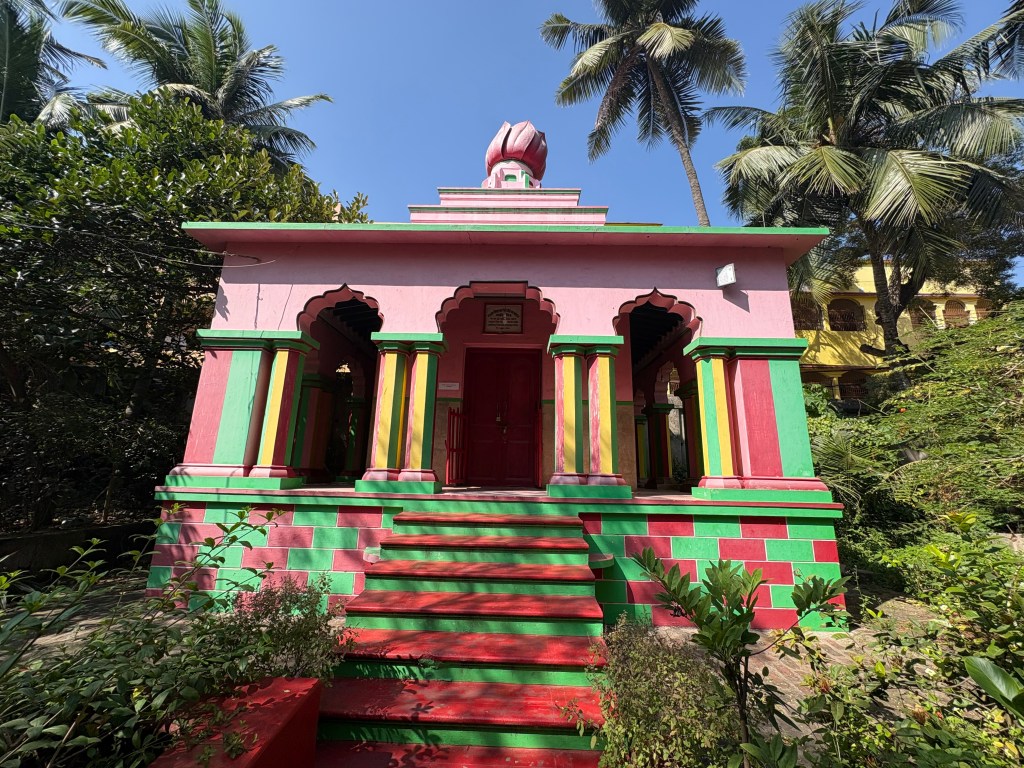
After entering through a simple gate, I found some gentlemen speaking beneath a few trees. I identified one immediately as the president of the ashram, Swami Yogaswarananda. I joined my palms in pranam and sat quietly as they conversed. Soon a young man, Simhachalam, appeared and showed me to the Mandir Samadhi Shrine of Swami Sri Yukteswar. He allowed me to look inside, where a large image of Swamiji greeted me. A lovely fragrance filled the chamber. I closed my eyes and allowed the vibrations to wash through me, and since it wasn’t allowed to meditate inside, I sat outside and delved within.
The silence was deafening, simply because this was the first place where I had found such quiet since my arrival. Thrilled to be here, my mind raced. As I struggled to still my thoughts, the words of Swamiji to Mukundu (Yogananda’s previous name) rang in my head. When Swamiji called to Mukunda and Mukunda protested that he was meditating, Swamiji said, “I know you are meditating, with your mind distributed like leaves in a storm!”
Soon I achieved some semblance of quiet in my mind, and at that moment I felt an insect biting the back of my neck. Soon others were biting my legs. Hesitant to strike, I remembered the incident when a mosquito was tormenting Mukunda as he meditated. When the mosquito bit his thigh, he raised his hand to strike it but hesitated due to the principle of ahimsa (non-violence).
“Why don’t you finish the job?” his Guru asked.
“Are you advocating taking a life?” Mukunda asked.
“No, I am not… But in your mind you have already done the deed of killing the mosquito. Killing the mosquito or sparing it now does not make that much of a difference.”
For Mukunda, every moment provided spiritual lessons at this ashram. The lesson here is that thoughts are potent, and even the desire to do harm commits violence. Part of purifying the mind involves ridding it of all aggressive projections or thoughts toward others. You may not act on your impulses, but your intent can easily be felt and create pain, and worse, such violence still exists in your heart to poison future thoughts and deeds.
I opened my eyes and saw that an army of ants marched across my body. I refrained from killing them and closed my eyes. Soon someone was sweeping all around me. Sweep, sweep, sweep. Closer and closer it came. A baby wailed from a nearby building. So many tests! I peeked out of one eye to see a young woman in colorful garb clearing the walk of leaves. I closed my eyes and tried to find silence within.
I eventually succeeded, and it was then that I felt the strong presence of both Yogananda and Swami Sri Yukteswar, and the overwhelming feeling I got was the divine love they had shared. So pure. The guru-disciple relationship is like no other. Indeed, the very first sentence of Autobiography of a Yogi is this: “The characteristic features of Indian culture have long been a search for ultimate verities and the concomitant disciple-guru relationship.”
Such a relationship provides the necessary path, wisdom, and aid for a disciple to follow in his/her spiritual quest. Guru means, “dispeller of darkness.” A disciple and guru exchange unconditional love, with the guru there for the sole purpose of aiding the devotee along the path to liberation, for the guru has already walked the path and knows the way. No matter how much the disciple may struggle and fall, the guru will be there to pick him up and help him on his way again.
I know this from personal experience. My Guru no longer resides on this earth, but his presence in my life never wavers, no matter how many times I may slip and fall. In fact, I feel Guruji’s presence stronger when I struggle with my discipline. He is there to encourage me and push me beyond all limitations that I impose on myself, for he knows the divinity of my soul.
I finished my meditation and sat with Simhachalam for some time beneath a tree while he stitched the binds of booklets. Before leaving Simhachalam informed me that I could stay here in a simple room for the meagre price of 700 per night — less than $10. It would take me until tomorrow to understand the significance of this remark.


 Divine Warrior
Leave a comment